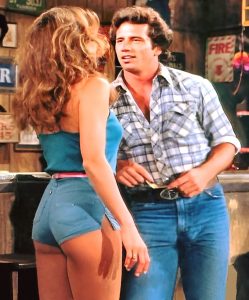
The classic television series The Dukes of Hazzard (1979–1985) is legendary for its high-octane car chases, death-defying jumps, and Southern charm. However, producing 147 episodes of intense automotive action on a tight TV budget and schedule led to a treasure trove of on-screen slip-ups, continuity errors, and production anomalies. Many of these flaws are easily missed unless you know exactly where to look.
The Ever-Changing General Lee
The most prominent “character” in the show, the 1969 Dodge Charger known as the General Lee, was actually a rotating fleet of vehicles. Because the show’s spectacular jumps frequently totaled the cars upon landing, producers destroyed an estimated 300 to 317 Chargers over seven seasons.
This massive vehicle turnover led to numerous, glaring continuity errors regarding the car’s physical appearance, often within the exact same sequence:
- The Roof Flag: While the iconic Confederate flag was painted on the roof, the fine details frequently shifted. In several early episodes, the flag was mistakenly painted backward or had a varying number of stars depending on which local body shop rushed the car to the set.
- The Changing Models: Sharp-eyed car enthusiasts will notice that the General Lee constantly morphs between a 1968 and a 1969 Dodge Charger. The easiest way to spot this mistake is by looking at the taillights and the front grille. A 1968 Charger features a solid grille and round taillights, while the 1969 version has a split grille and long, horizontal taillights. The show regularly cut between the two models in mid-chase.
- Miraculous Self-Healing: During high-speed pursuits, the General Lee would frequently suffer heavy dents, lose its hubcaps, or smash its front quarter panels against a ditch. Seconds later, as the car sped around the next bend, the damage would completely vanish, and the hubcaps would magically reappear.
Weight Blocks and Stunt Doubles
To make the heavy Dodge Charger fly level through the air during its famous jumps, the crew had to place heavy ballast—often hundreds of pounds of concrete or sandbags—inside the trunk. Without this rear weight, the heavy front engine would cause the car to nose-dive straight into the dirt.
If you freeze-frame the jumps, you can easily spot the ballast shifting or see structural support bars welded inside the cabin to protect the stunt drivers. Furthermore, the glass window glass was entirely removed from the General Lee to allow Bo and Luke to slide through the windows easily. However, in several close-up driving scenes, reflections from non-existent glass can accidentally be seen, revealing the use of standard, non-modified studio mock-ups.
Wardrobe and Audio Slip-Ups
Beyond the automotive blunders, the human cast had plenty of overlooked continuity errors. The main characters famously wore identical outfits in almost every single episode to make editing easier and allow seamless matching with stock stunt footage.
Even with this simplified wardrobe system, mistakes slipped through. In multiple scenes, Luke Duke’s signature blue checkered shirt shifts between different patterns of plaid between camera cuts. Additionally, during intense fight scenes, the stunt doubles for Bo, Luke, and Boss Hogg are frequently fully visible. The doubles often sported completely different hair lengths or wore poorly fitted wigs that shifted during physical struggles.
On the audio side, tire-screeching sounds were frequently overlaid onto dirt roads. The General Lee spent the majority of its time tearing down unpaved, dusty country pathways in Hazzard County, yet the audio track continuously played the high-pitched squeal of rubber burning against hot asphalt.
These tiny technical errors do not diminish the legacy of The Dukes of Hazzard. Instead, they highlight the frantic, practical filmmaking style of a bygone television era.
If you’d like, I can break down the stunt budget, detail the exact episodes featuring the most famous jumps, or look into the 2005 movie adaptation bloopers. Which would you like to explore next?
